

Article
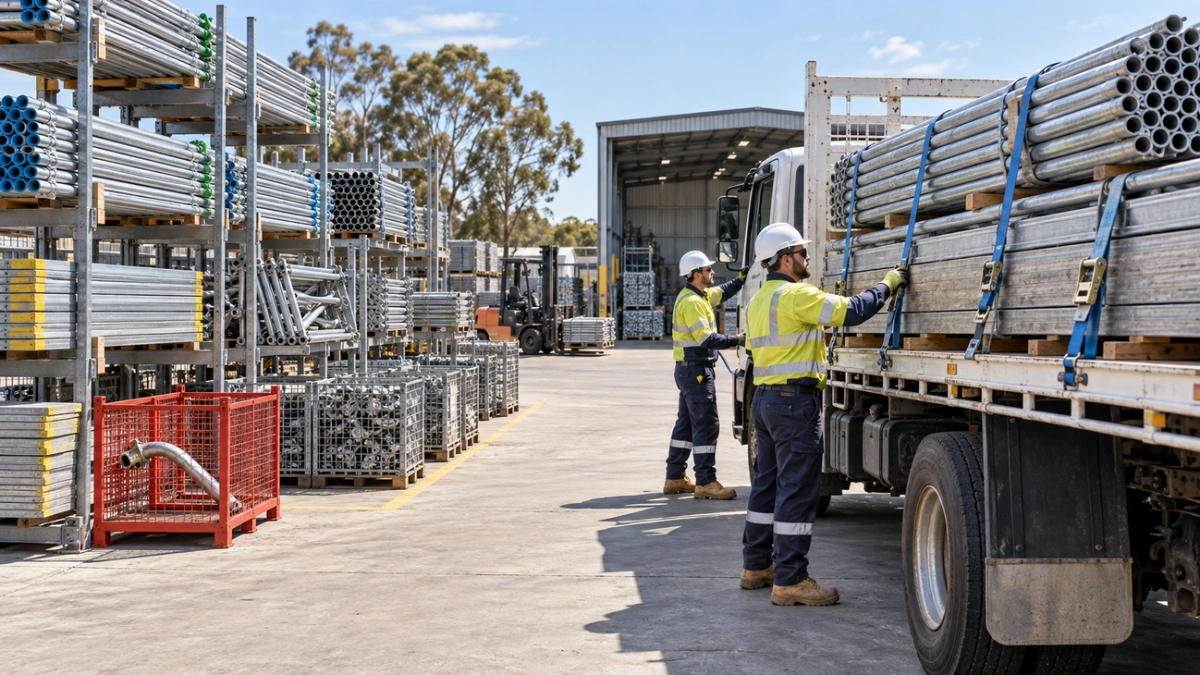
Most scaffolding businesses lose more money in the yard and on the truck than they do on site. Components go missing between jobs, bent ledgers get stacked with good stock and reappear at 6am on a Monday, and a load that was thrown together in the dark becomes a compliance problem on the highway. None of this is dramatic, which is exactly why it persists. This article sets out a repeatable handling system from the moment a scaffold comes down to the moment it is craned or carried onto the next site, covering stripping, inspection, quarantine, stacking, loading, restraint and stock control, with the Australian rules that actually apply to each stage.
Why the handling system decides site productivity
Scaffolding is bought as a system and only works as a system. A pack that arrives missing eight transoms or carrying a dozen unusable braces does not just delay erection; it pushes crews into improvising with mismatched components, which is where structural problems begin. Treating the yard as part of the job rather than a place where gear is dumped between jobs is what keeps counts accurate, damage visible and erection times predictable.
Strip the scaffold with the return in mind
Dismantling is the first stage of storage. Sorting as components come down, rather than sorting later from a pile, is the single largest time saving available. In practice that means designating landing areas by component type before the first tie is released, lowering components rather than dropping them, and banding or caging small items such as couplers, pins and toe-board brackets immediately, because those are the parts that disappear.
Keep the same rules that applied during erection. Dismantling remains scaffolding work, so where the fall risk exceeds 4 metres it must be carried out by a worker holding the appropriate scaffolding high risk work licence, and dropping components to clear a deck faster is never an acceptable shortcut.
Inspect and quarantine before anything is stacked
Inspection belongs at the point of return, not at the point of dispatch. Once a damaged component is buried in a stack of forty, it will not be found until someone is holding it on a deck.
Look for:
- Bent, kinked or dented standards, ledgers and transoms, and any distortion around spigots and joints
- Cracked, torn or elongated cup and wedge fittings, damaged locking pins and worn brace ends
- Split, delaminated or water-damaged timber and LVL planks, and buckled, cracked or heavily corroded steel planks
- Seized or bent screw jacks and base plates, and damaged threads
- Corrosion beyond surface staining, particularly at welds, ends and inside tube
- Missing or unreadable manufacturer identification and duty marking
- Impact damage on aluminium, which tends to crack rather than bend
Anything questionable goes into a physically separate, clearly marked quarantine area, not back on the rack. Repairs and modifications should follow the manufacturer's or designer's instructions and be assessed by a competent person, and equipment used at a workplace needs to comply with the relevant parts of the AS/NZS 1576 scaffolding series. Where damaged stock takes a bay out of service, replacing standards, ledgers and transoms from a matched system avoids the slow drift toward mixed, incompatible gear.
Clean and protect what goes into storage
Cleaning is not cosmetic. Concrete slurry, render and mud hide cracks, jam wedge fittings and accelerate corrosion. Knocking off build-up, clearing threads on jacks and letting timber planks dry before stacking costs very little and extends component life considerably.
Store galvanised steel off the ground, with airflow between layers, and avoid trapping water between stacked components, which is what causes white rust. Keep aluminium separate where possible, since aluminium towers and lightweight decking are easier to damage under the weight of steel and behave differently in contact with other metals in wet conditions. Timber and LVL should be stacked flat, supported at regular intervals and kept out of standing water and direct weather.
Organise the storage area
A good yard layout is designed around how gear is picked, not how it happens to arrive. Group by component type and then by size, label racks and stillages clearly, and keep frequently used sizes closest to the loading area. Store heavy items low. Keep stacks at a height where the top item can be handled without reaching above shoulder height, and keep stack faces vertical so nothing topples when the front item is drawn.
Walkways between racks should stay clear, wide enough for the mechanical handling you actually use, and free of the loose pins, planks and offcuts that create trip hazards in a working yard. Ancillary gear such as props and their accessories deserves its own zone rather than being wedged in among scaffold stock, because mixing them is how counts drift.
Loading and restraining for transport
Load restraint is where scaffolding businesses carry the most regulatory exposure, and the rules are specific. Load restraint performance standards require a restraint system able to prevent load movement under 0.8g or 80% of the weight of the load forwards, 0.5g or 50% of the weight sideways and rearwards, and 0.2g or 20% of the weight upwards where friction is relied on to withstand the force in other directions.
The reference document depends on the vehicle. The NHVR published a fourth edition of the Load Restraint Guide in June 2025, with changes that are primarily cosmetic, and the 2018 edition remains current and valid for use. That guide covers heavy vehicles. The National Transport Commission maintains a separate Load Restraint Guide for Light Vehicles, covering any car, ute, van, truck or trailer with a gross vehicle mass up to 4.5 tonnes, which is the category most scaffolding utes and tandem trailers fall into.
Practical points that follow from those standards:
- Tube, standards and ledgers are round and want to roll, so they need containment as well as tie-down. Gates, headboards, pipe stakes or purpose-built cradles do more than extra straps.
- Bundle like with like and band bundles before loading so the restraint acts on a solid unit rather than loose sticks.
- Place heavy items low and forward of the rear axle group, keeping the load within the vehicle's mass limits and stable in cornering.
- Use rated restraint equipment with identifiable markings, and check webbing, hooks and ratchets before each trip. Damaged straps are replaced, not knotted.
- Re-check restraint after the first part of the journey, since bundled loads settle.
Load restraint duties under heavy vehicle law extend beyond the driver to others in the chain of responsibility in most Australian jurisdictions, so the person loading the truck carries real obligations. Confirm the position that applies where you operate.
Protecting workers during loading and unloading
Loading and unloading is repetitive lifting of long, heavy, awkward items, often at a rushed point in the day. Manual handling risks must be managed under WHS law in every jurisdiction. Mechanical aids do the heavy work where they can: forklifts, crane trucks, stillages and cages designed for the component. Where items are handled by hand, share loads between workers, keep them close to the body, avoid twisting under load, and avoid working from the tray edge.
Nobody should stand under a suspended load or on the load itself while it is being restrained. Where the deck height makes that unavoidable, the fall risk needs its own control rather than being accepted as part of the job.
Tracking stock and reducing loss
Losses are usually small, constant and invisible until a stocktake. Counting components out and back on every job, recording the count against the job rather than the truck, and reconciling at the end of each hire is what turns shrinkage into a number someone owns.
Colour coding by set, stencilled or stamped identification, and banded bundles with a known count all reduce miscounts. Recording inspection outcomes alongside the count builds a maintenance history over time, which is useful both for planning replacement and for demonstrating that equipment has been maintained.
Yard and transport checklist
- Landing areas designated by component type before dismantling starts
- Every component inspected on return, with damaged stock quarantined physically and marked
- Components cleaned, dried and stacked off the ground with airflow
- Racks labelled, heavy items stored low, walkways kept clear
- Load planned for mass distribution before the first item goes on
- Round components contained as well as strapped
- Rated restraint equipment checked, and restraint re-checked early in the journey
- Counts recorded out and back against the job
- Gear inspected again before erection on the next site
Conclusion
Storage and transport are quiet processes that quietly decide margins. A consistent sequence of strip, inspect, quarantine, clean, stack, count and restrain keeps damaged gear out of circulation, keeps loads legal, and means the next crew opens a pack that is complete and ready to build. If replacing quarantined stock is starting to disrupt job planning, it is worth reviewing your component mix with a supplier who can match replacements to the system already in your yard.
FAQs
How should scaffold planks be stored?
Flat, supported at regular intervals to prevent sag, off the ground, and under cover where possible. Timber and LVL planks should be dry before stacking and kept out of standing water, since moisture causes splitting and delamination that can be hard to see once stacked.
What are the legal requirements for transporting scaffolding?
The load must be restrained so it cannot move relative to the vehicle, meeting the performance standards of 0.8g forwards, 0.5g sideways and rearwards, and 0.2g upwards where friction is relied on. Use the NHVR Load Restraint Guide for heavy vehicles and the NTC light vehicle guide for vehicles up to 4.5 tonnes GVM, and check the chain of responsibility duties applying in your jurisdiction.
Can damaged scaffold components be repaired?
Only in accordance with the manufacturer's or designer's instructions, and assessed by a competent person. Straightening a bent component in the yard is not a repair, because the material has already been affected in ways that cannot be judged by eye.
Does scaffolding need to be inspected before it goes back out?
Yes, and again once erected. A scaffold must be inspected by a competent person before use, and where a person or object could fall more than 4 metres, at intervals not exceeding 30 days as well as after incidents, repairs or alterations.
How can a scaffolding business reduce component loss?
Count in and out against each job, band small items into fixed-count bundles, mark stock with a business identifier, and reconcile at the end of every hire rather than at stocktake. Most losses are a handful of couplers and pins at a time, which only becomes visible when it is measured.


